In Riyadh, confronting the climate challenge goes far beyond drafting new building codes – it requires rewriting the very grammar of the landscape. Between cliffs that stretch toward the horizon and new expanses of greenery that promise life, infrastructure sheds its imposing presence to become an organic extension of the terrain. This is a look at how geotechnical technology is making the extreme habitable, weaving together rock and human vision.
In the vast Saudi desert, the traditional distinction between what is created by nature and what is shaped by human ingenuity has become almost obsolete. Where extreme environmental conditions – from relentless aridity to unstable soils, from hydrogeological risks to sudden flash floods – make “original nature” insufficient to provide comfort and safety, a new design philosophy emerges. It is no longer about erecting barriers or forcing the landscape into submission, but about empowering it from within, shaping technical ecosystems that can endure, adapt, and thrive over time.
It is in this context – a vast open-air laboratory pulsing with the rhythm of Saudi Vision 2030 – that two of the decade’s most ambitious projects are taking shape: the Prince Mohammed bin Salman Stadium and King Salman Park in Riyadh. In both cases, Maccaferri’s role goes far beyond supplying structural solutions; it is helping define a new territorial grammar, where engineering becomes the invisible skeleton of a landscape in continuous and profound transformation.
The Architecture of the Precipice: Prince Mohammed bin Salman Stadium
Building a 47,000-seat stadium on the edge of a 200-meter cliff, destined to host the 2034 FIFA World Cup, is a feat that transcends conventional construction. Here, geology sets uncompromising limits: near-vertical slopes and the constant threat of flash floods, the sudden and violent inundations characteristic of desert environments. The response was not to impose foreign barriers, but to achieve a profound structural mimicry.
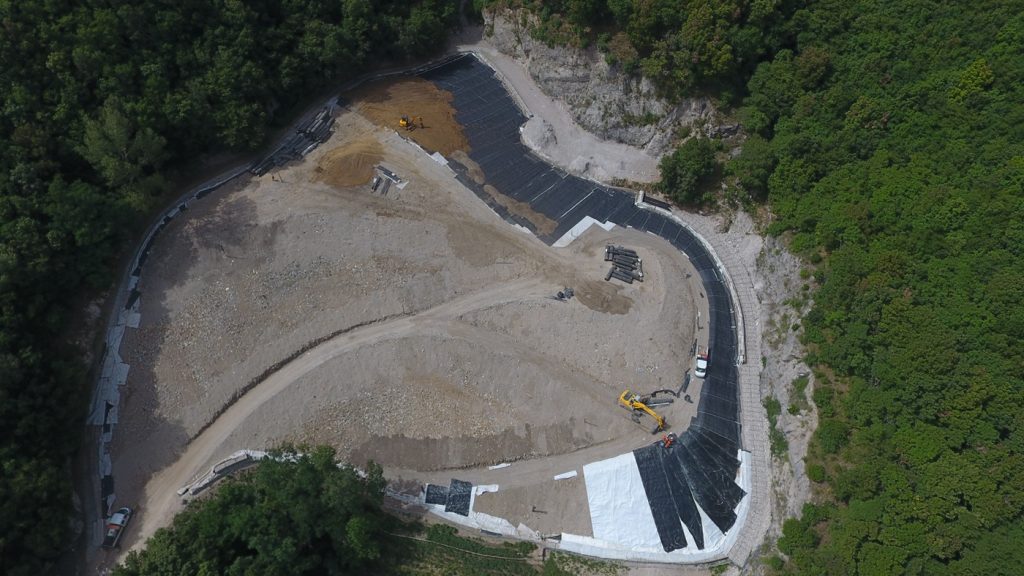
Retaining walls and access ramps – essential to “anchor” the stadium to the cliff—were conceived as seamlessly integrated with the site, thanks to the modular TerraMesh system. By using the site’s own rocks and excavated soil to fill the reinforcement structures, two important outcomes are achieved: a drastic reduction in carbon footprint (avoiding material transport and massive cement use) and the creation of a structure that, visually and mechanically, behaves like the mountain itself. This “geological prosthesis” is designed to manage powerful water flows through internal drainage systems and to ensure a lifespan exceeding 120 years. It is infrastructure that fades from view, leaving space for safety and the grandeur of the spectacle.
Reinventing Material
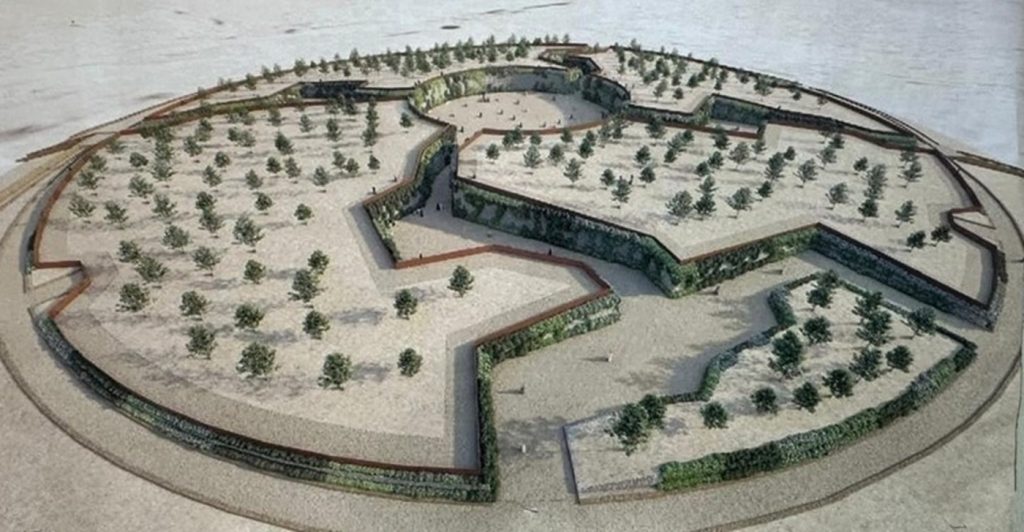
If gravity is the challenge at the Prince Mohammed bin Salman Stadium, memory defines the emerging King Salman Park. The project, poised to become the world’s largest urban park, requires transforming arid soil into a livable oasis while respecting the site’s profound identity. The client specifically requested the use of “Riyadh stone,” an iconic local limestone that, on its own, lacks the mechanical properties needed to support the massive retaining structures that shape the park’s topography.
The solution lies in hybridization, made possible by the TerraMesh Mineral system. This technology marries the “historic skin” of the local stone with a modern “core” of geosynthetic reinforcements. The over 12,000 square meters of walls and ramps are not merely boundaries – they are active, living elements that allow the park to breathe. They support the soil, integrate irrigation systems, and withstand thermal shocks, enabling vegetation to thrive in an otherwise hostile environment.
Towards Systemic Resilience
These interventions signal a fundamental shift in how we approach infrastructure. We are no longer dealing with static, inert structures, but with dynamic systems that require care and predictive maintenance, much like living organisms. The cut-and-fill strategy used in Saudi Arabia shows that sustainability is not a slogan – it is a built-in design strategy: reusing local materials to build the future reduces environmental impact while increasing territorial resilience. On a planet changing at unprecedented speed, true innovation is not resisting nature’s forces, but absorbing and managing them wisely – making life and development possible even where, left alone, nature would falter.
Article edited by the Second Nature editorial team, with contributions from Jayakrishnan Puthiya Veettil, Regional Technical Manager at Officine Maccaferri.