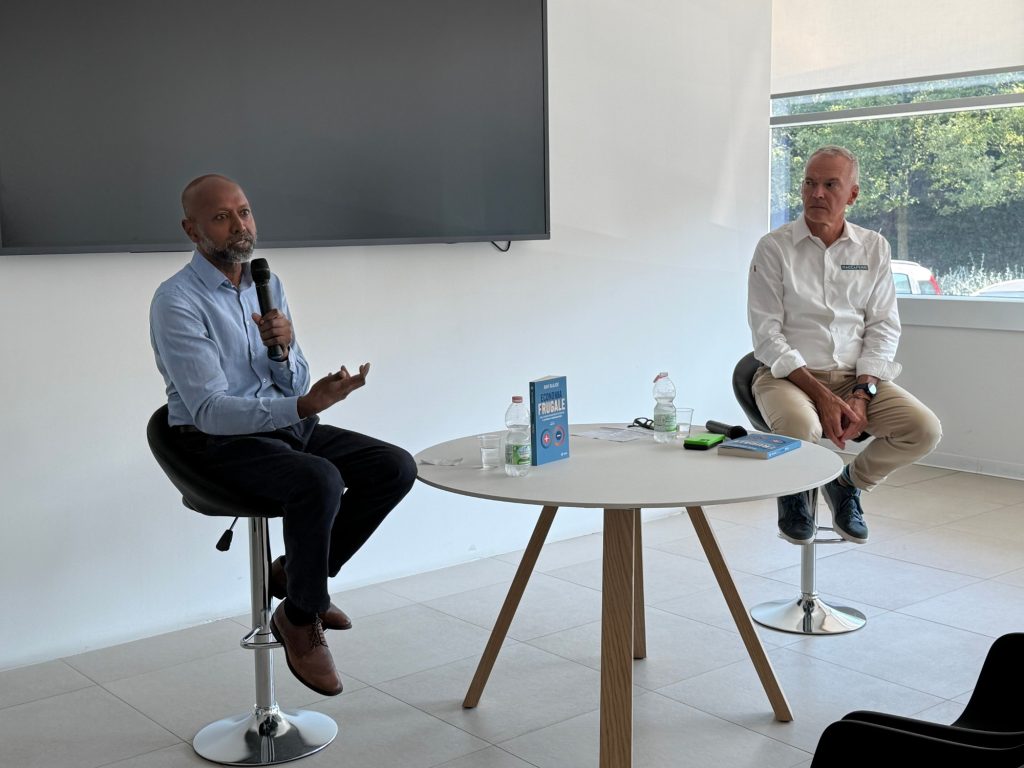
Twenty years ago I realized that while the West innovates according to the logic of “more resources generate more R&D,” in emerging markets like India, Africa and China innovation comes from ingenuity, with very few resources available. This idea of “doing better with less” gave rise to the concept of frugal innovation, which is now being adopted even by multinationals. But what happens if we apply this frugal mindset not to a single product, but to the entire economic system?
The question stems from a concrete urgency (growing scarcity of natural resources, geopolitical instability) and from a diagnosis that has matured over the years: today’s capitalism rests on three structural limits: extreme competition, hyper-globalized supply chains, and the obsession with extracting ever more raw materials at the expense of biodiversity. Against these three limits, I propose three values (cooperation, decentralization and regeneration), and companies able to adopt a distributed rather than concentrated structure are already naturally aligned with this vision.
Making things bear fruit, not cutting back
The word “frugal” comes from the Latin frux, fruit: frugality is not about reduction, but about creating value. I distinguish three levels. Optimization (doing more with less) is something companies already know how to do well: it’s no coincidence that Italy is the European leader in resource productivity, generating 4.7 euros of economic value for every kilogram of material used, more than Germany and France. Minimization, on the other hand, concerns the systematic reduction of resources that are becoming objectively scarce. Water is one example: by 2030, demand for fresh water will exceed supply by 40%, and in 2022 France launched an energy “sobriety” plan asking businesses to cut consumption by 10%.
The third level is valorization: discovering hidden value in resources that were right in front of us but that we didn’t know how to appreciate. Take the example of the Prato textile district, which stopped importing wool from the other side of the world and started recycling used clothing collected within 30 kilometers of its plants, turning local textile waste into a veritable “urban mine,” generating value for the local community rather than for distant conglomerates.
Four pillars, three regenerations
My model of frugal economy rests on four pillars: the sharing of underused assets and resources between companies; decentralized production, moving from large factories to micro and nano-plants spread out and rooted in local communities; the replacement of global chains with hyper-local value networks, rather than simply moving production from one continent to another; and finally what I call “triple regeneration,” of people, places and the planet.
There is no shortage of examples. Andrea Illy, chairman of Illycaffè and founder of the Regenerative Society Foundation, invests in regenerative agriculture that can sequester CO2 and revitalize depleted soils, while also generating more income for farmers. Decathlon is opening stores in France certified “Biodiversity Signature,” with 70% of the surface dedicated to green spaces that give room back to local flora and fauna. The Regenerative Society Foundation itself is working on the rebirth of small villages in Emilia-Romagna, bringing tourism and culture to places otherwise destined for depopulation. And in Japan, the insurance company Meiji Yasuda, after 145 years in life insurance, has reinvented itself as a provider of wellness services, in response to a population that is aging, living longer, but also increasingly isolated: an issue that will soon concern Italy too, which is on track to overtake Germany as the second oldest country in the world after Japan. Finally, I find particularly significant the projects, in Israel as well as in Emilia-Romagna, that involve people with depression or on the autism spectrum in regenerative agriculture activities, with benefits that can be measured even at the neurological level: proof that regenerating people, places and nature are, at bottom, the same thing.
From one center to many centers
To explain this change, we can point to Giordano Bruno, the Italian philosopher who in 1600 paid with his life for his unorthodox vision of an infinite universe with no single center, and Elinor Ostrom, the first woman to win the Nobel Prize in economics, who argued that commons such as groundwater basins and fisheries are better governed locally than by a distant decision-making center. Hence the shift from monocentric governance models to “polycentric” ones: Saint-Gobain, a French building materials company with 360 years of history, is becoming “hyper-national,” giving greater autonomy to each of the countries where it operates, and localizing in each territory not only production but also research and development. It’s an idea that recalls the concept of the “extended mind,” which we sometimes use to describe precisely this kind of networked organization: leading no longer a single company, but a network of local hubs, leaving them autonomy while at the same time finding a way to circulate knowledge and best practices among all of them.
Agility, ingenuity, empathy
The idea of a frugal mindset is often condensed into three qualities: the agility of someone who, like the “bricoleur” described by the anthropologist Claude Lévi-Strauss, starts from what is available rather than chasing the ideal solution, aiming not for perfection but for perfectibility; the intuitive ability to mobilize even intangible resources, such as the tacit knowledge held in different departments of the same company, which artificial intelligence can now help circulate and enhance in a true “circular economy of knowledge”; and empathy, which I urge extending beyond customers to society as a whole. Siemens, for example, plans its investments starting from the future needs of the countries where it operates, to the point of being perceived everywhere as a local company. One final form of empathy is empathy toward oneself: a lesson I learned the hard way, twenty years ago, after an episode of burnout. Taking care of yourself and taking care of society go hand in hand.
As for artificial intelligence, I consider it a powerful ally of frugality: it can simultaneously optimize multiple variables (economic, social, environmental) where the human analytical mind struggles, and bring out hidden patterns in the tacit knowledge accumulated by a company with over a century of history. But my message, in the end, is a different one: the more powerful artificial intelligence becomes, the more it puts us in front of a mirror, forcing us to recognize what truly makes us human, a fundamental point also emphasized by Pope Leo XIV in his recent encyclical Magnifica Humanitas. For every company, the challenge will be to clearly define its own distinctive DNA, because artificial intelligence, in itself, creates nothing new: it only amplifies what we already are.
Navi Radjou
Innovation Scholar & Author
Last Articles
The meaning of work: flourishing, not just producing
Efficiency + Sufficiency: a new sustainability paradigm for European housing policies