
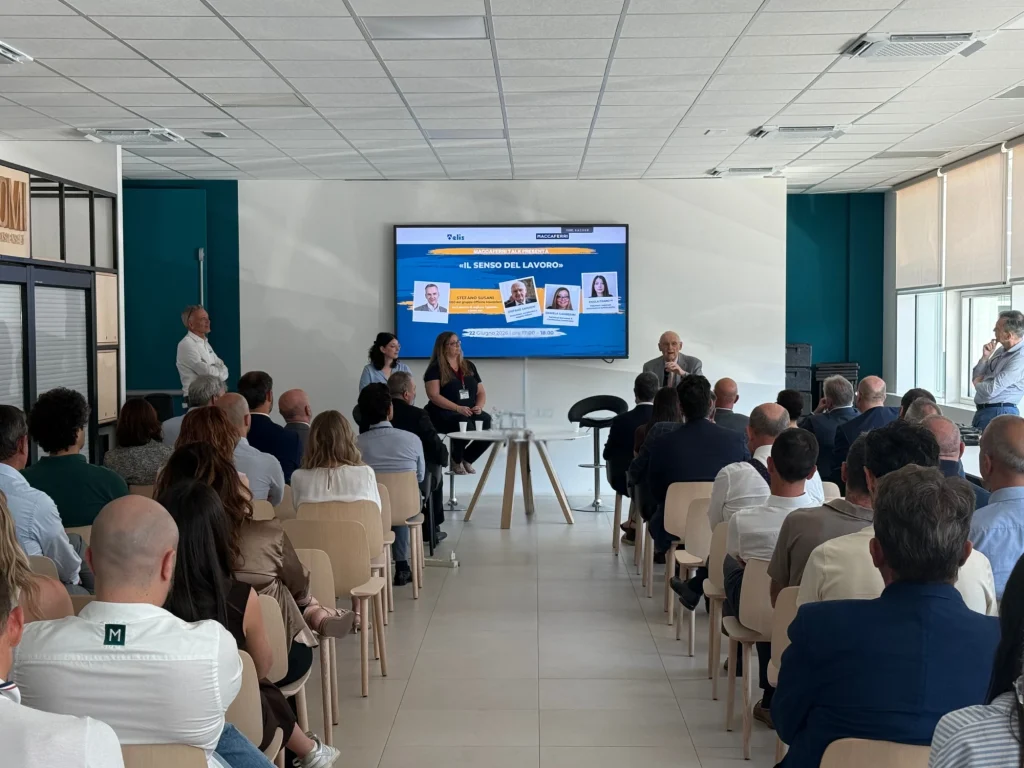
In Italian, the word “senso” has two semantic fields: it means “meaning,” but also “direction.” So when we talk about the meaning of work, we can ask what work means to us, but also where it is heading.
It is from this second sense that I’d like to start: what is the direction of work today?
To try to answer, it helps to take a step back, because the relationship between humankind and work has a very long history.
At the origins of the enterprise
The Benedictine monastery can be considered the first true company in history. It arose from the monks’ need to provide for their own sustenance. It was in that context that Saint Benedict coined an expression that, for the time, could sound almost like blasphemy: ora et labora. Prayer and work are placed on the same level, granting work a dignity that had not been recognized until then.
A few centuries later, it was Saint Francis, the son of an entrepreneur, who introduced another fundamental step: economic activity should not have the accumulation of wealth as its ultimate goal, but the common good.
It is a legacy that was taken up by the Franciscans and that contributed to the birth of the market economy in fifteenth-century Tuscany and Umbria. Market economy and capitalism are not the same thing, even though Marx later tended to confuse the two concepts.
The Monti di Pietà also date from that period, among the first financial institutions created with a very specific purpose: to support those who produced. A Franciscan maxim of the time said: “alms help you survive, but not live, because living is producing.”
Since then, work has gone through enormous transformations: the first industrial revolution in England, the second in Germany, the third launched in California in the 1970s. But one fundamental question has remained open.
Just work and decent work
Work, in fact, has two dimensions, not just one.
The first is the extractive dimension: we work to earn the income we need to live. This is the theme of “just work,” which Leo XIII already discussed in Rerum Novarum in 1891. Today, at least conceptually, this principle can be considered established: work must be adequately paid.
But there is a second dimension, the expressive one. Through work, everyone must be able to realize their potential. This is the dimension of “decent work.”
So paying well is not enough. People must be allowed to flourish.
The concept of flourishing is essential to understanding what we mean when we talk about happiness. Happiness, in the Greek sense of eudaimonia, is not contentment, nor is it a stroke of luck. It is a flourishing, like flowers in spring.
And we flourish through the exercise of virtues: creativity, fortitude, resilience.
What makes us human in the age of artificial intelligence
This distinction becomes particularly important today, in the face of the development of artificial intelligence.
The Nobel laureate James Heckman distinguishes between cognitive skills and character skills. The former are those we have traditionally associated most with knowledge and professional training. But they are also the ones in which artificial intelligence is demonstrating ever greater capabilities.
Character skills (creativity, fortitude, resilience) therefore take on growing importance. And it is in these too that the worlds of education and business will have to learn to invest.
This leads directly to another issue: tacit knowledge.
The philosopher Michael Polanyi used the term “tacit knowledge” for everything a person knows but that no manual can fully convey. It is the knowledge that comes from experience, from work, from relationships, from the ability to deal with concrete situations.
Every person possesses an enormous amount of tacit knowledge. But this knowledge has a fundamental characteristic: it cannot simply be extracted. A person decides to share it only if the context in which they work allows it.
The challenge then becomes building organizational models capable of bringing this knowledge to the surface and enabling people to make it available to others.
It is a different perspective from that of the Taylorist model, which tended to regard the worker mainly as an executor and to separate knowledge from the person doing the work.
The role of the enterprise
If we accept this perspective, what we ask of a company also changes.
We cannot limit ourselves to considering work as an exchange between performance and remuneration. An organization must certainly be able to deliver results, but it must also create the conditions for people to express their potential, share what they know and recognize meaning in what they do.
This is where the expressive dimension of work becomes decisive.
Artificial intelligence will be able to replace a growing part of our cognitive skills. This doesn’t mean we should look to the future with pessimism. On the contrary, this very transformation can force us to bring back to the center what distinguishes the human contribution: character skills, the capacity for relationship, tacit knowledge, creativity.
The question is not only how much we will be able to produce, but what conditions we will be able to create so that people can flourish through their work.
Because work is not only a means of subsistence. It is also one of the places where each of us can leave a part of ourselves and receive something in return.
And perhaps this is precisely the challenge before us: to build organizations in which work is not only production, but also an opportunity for flourishing.
As Tolstoy reminds us: “if you feel pain, you are alive, but if you feel the pain of others, you are human.”
My hope, then, is that we can always remain “in joy” (not simply content) whatever work asks us to face.
Stefano Zamagni
Docente di Economia Civile, Università di Bologna; Adjunct Professor di Relazioni Internazionali, SAIS Europe Johns Hopkins University; Pres. Emerito della Pontificia Acc. Di Scienze Sociali
Last Articles
Frugal Economy: making things bear fruit, not just cutting back

Efficiency + Sufficiency: a new sustainability paradigm for European housing policies