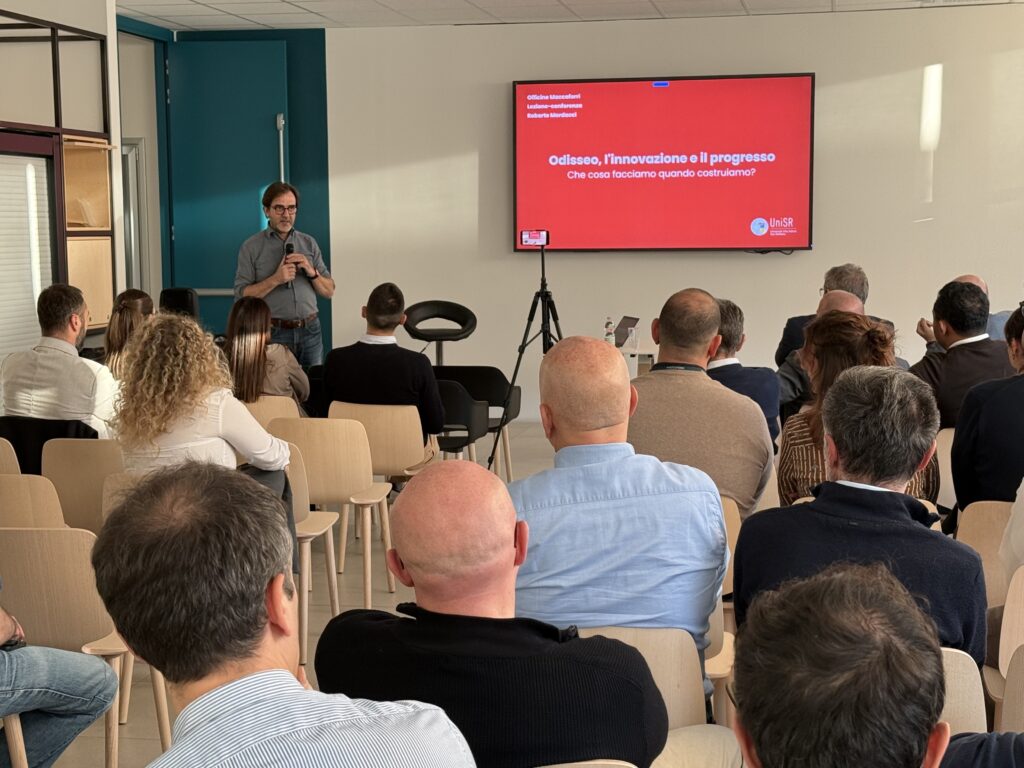
I am a moral philosopher, not an engineer: those who build embankments, stabilise slopes and deliver infrastructure know how to do what I can only try to question. I start from a simple conviction: the most important questions about technology are not technical questions. They are questions about what kind of human beings we want to be and what kind of world we want to share.
No stability calculation can tell us which slope to secure first, who a structure is built for, at what cost and at whose expense. Calculation tells us how; it does not tell us why, or for whom. To explore these questions I propose three distinctions: technique is not technology, innovation is not always progress, and progress is more than technical innovation.
Technique is not technology
Technique is a fundamental human capacity: it arises from the need to find food, build shelter and survive in an environment that does not care about us, and every community, in every era, has its own. Technology is something more specific: it is the embodiment of that capacity within a particular form of life, with its values, its fears, its hierarchies. Technique is the potential; technology is what that potential becomes when a society shapes it.
Humans have always needed to defend themselves from water and to hold the earth in place. An embankment built by a farming community through everyone’s labour and a river-engineering structure of today, with industrial materials, standards, testing and global supply chains, answer the same technical need but belong to different technologies: they embody different relationships between human beings, land, labour, time and responsibility.
It follows that there is no “pure” technique, and no neutral technical rationality. Even “optimising” is never a purely technical matter: cost, installation time, durability, environmental impact and the safety of those living downstream are different objective functions, and choosing which to weigh most heavily is a choice of value. A design is never innocent: it is condensed philosophy, whether the designer knows it or not. That is why the right question is not whether a technology is good or bad in itself, but what form of life it embodies, what interests it serves, and what human relationships it makes possible or impossible.
Innovation is not always progress
To innovate means to introduce a new way of doing something: it is a morally neutral concept. Yet innovation has absorbed the prestige that once belonged to progress, as if novelty in itself were already a reason to welcome something. Confusing the two is, in my view, one of the great mystifications of our economic culture. The market, which often innovates around marginal or fabricated problems while leaving real needs unanswered because they are not profitable, is very good at discovering what can be sold; it is not automatically good at discovering what is needed.
From this follows the question of justice. A truly useful innovation — in medicine, in education, in connectivity, today in artificial intelligence — that remains the privilege of those who can pay for it does not lift humanity up: it stratifies it. Infrastructure shows this clearly: a major work can magnificently protect a city while offloading the risk onto a weaker territory, and the most fragile areas, often the most exposed to landslides, floods and erosion, are left behind. Hence a thesis I consider an ethical principle of our time: there is no true innovation without justice. An advance that increases wealth, knowledge or convenience but widens the gap between those who benefit and those who bear the cost may be a technical success; it is not a human success. Justice is not a constraint to be added after the fact, in the form of regulation: it belongs to the very definition of good innovation.
The critical point is design
The critical point of good innovation is its design, in the broadest and also most engineering sense of the term. Take artificial intelligence: the ethical stakes lie not mainly in its use, nor only in regulation, but upstream, in design choices. Which data train a system, which objectives are optimised, which trade-offs between fairness, transparency and profitability are made, and by whom.
Those who design structures know this from experience: once the safety factor, the return period of the design event, the materials, the service life and the maintenance criteria have been set, most of the consequences are already decided — who will be protected, for how long, at what environmental cost, with what burden for those who come after. Construction and acceptance testing carry out choices made earlier: by those who commission the work, in funding, in land-use policy. Ethics that arrives afterwards, as repair of the damage, has already lost the most important ground. That is why it cannot be left to philosophers: it must sit at the design table, and wherever it is decided what should be designed and with what resources.
Progress is emancipation
Progress cannot be reduced to technical innovation, however just. It unfolds in three connected dimensions: cognitive, as a deepening of our understanding of the world and of ourselves, including awareness of the limits of our models; moral, as a growing capacity to recognise others as bearers of dignity and to translate that recognition into what we do; and social, as equity, that is, institutions and distributions of power and resources that make progress effective for the many and not merely conceivable for the few. Innovation can serve all three, but it is a tool, not progress itself, and it can just as easily work against each of them.
I propose to define progress as an improvement in our capacity to face problems: to perceive them accurately, to formulate them adequately, to hold them without panic or denial. It is not simply “problem solving”, because some solutions are regressive. They eliminate a symptom while worsening the structure that produced it, or shift the problem onto others: future generations, distant populations, non-human nature. A solution can also close off our future capacity to face problems, making us passive and outsourcing judgement to systems we do not understand and cannot contest. That is regression dressed in the vocabulary of progress.
The deepest criterion, which I take from Herbert Marcuse, is that progress implies the empowerment and emancipation of human beings in their relationships with one another: not isolated individuals accumulating private capabilities and private comforts, but the growing capacity of people to recognise one another, to depend on one another without domination, to negotiate their common world as equals. A technology that increases what an individual, a business or a state can do and at the same time diminishes people’s capacity to relate to one another as free and equal agents takes us backwards, however technically sophisticated it may be.
Three questions for those who design
Technique is universal; technology is always situated, never neutral. Innovation is the beginning of a question, not its answer. Progress is the growth — cognitive, moral and social — of our shared capacity to face problems without abandoning one another.
To those who work where technique meets the earth, the water and communities, I leave three questions to bring to the design table: what form of life does this solution embody? Which interests does it serve, and which does it leave out? Which relationships between people does it make possible, and which impossible? They do not replace calculation: they orient it. The purpose of technology cannot be the advancement of technology itself; it can only be borrowed from a shared idea of what it means for human beings to live well together, as free and equal participants in a common world. It is not something engineering will discover for us: we must keep discussing it, and keep building it, together.
Roberto Mordacci
Full Professor of Moral Philosophy and Pro-Rector for Humanities and Social Sciences at Vita-Salute San Raffaele University, Milan
References
Acemoglu D., Johnson S., Potere e progresso. La nostra lotta millenaria per la tecnologia e la prosperità, Il Saggiatore, Milano 2023
Allen A., La fine del progresso. Decolonizzare i fondamenti normativi della teoria critica, Castelvecchi, Roma 2025
Arendt H., Sulla violenza, Guanda, Milano 2017
Honneth A., Il lavoratore sovrano. Lavoro e cittadinanza democratica, Il Mulino, Bologna 2025
Jaeggi R., Progresso e regressione, Castelvecchi, Roma 2025
Kant I., Idea per una storia universale in prospettiva cosmopolitica, Mimesis, Sesto San Giovanni 2015
Mordacci R., Respect and Power. The Foundations of Critical Ethics and Politics, Routledge, New York & Oxford 2025
Last Articles

Efficiency + Sufficiency: a new sustainability paradigm for European housing policies
Vertical symphony: the invisible understanding between man and mountain