Where the river rises: engineering memory at the heart of Mesopotamia
In southeastern Turkey, where the Tigris curves through millennia of sediment and stone, Hasankeyf — a city 12,000 years old, a crossroads of Romans, Byzantines, Artuqids, Ayyubids and Ottomans civilizations — was destined to disappear beneath the reservoir of the Ilısu Dam. Before the waters rose, major monuments including mosques, tombs, historic gates and other cultural landmarks weighing over a thousand tons each were transported to higher ground and reassembled at the new Hasankeyf Archeopark. What emerged was a cultural landscape anchored to the riverbank, designed to carry the weight of history into a future defined by seasonal floods and seismic uncertainty.
Engineering against time and water
The slopes along the park’s riverbanks were composed of loose to medium dense silty sand interlayered with weathered siltstone, presenting limitations in bearing capacity and global stability. Worse, the Tigris does not behave as a fixed boundary: retaining structures here would find themselves completely submerged in winter, then fully exposed to thousands of visitors by summer. The original design had called for concrete cantilever walls. But concrete fights water, trapping hydrostatic pressure with each cycle of saturation and drawdown. On soils this poor, rigidity becomes fragility. «Concrete walls fight against water», explains Ali Kemal Kermooglu, General Manager at Maccaferri Turkey. «Our systems work with water. That is the fundamental difference».
Structures that breathe
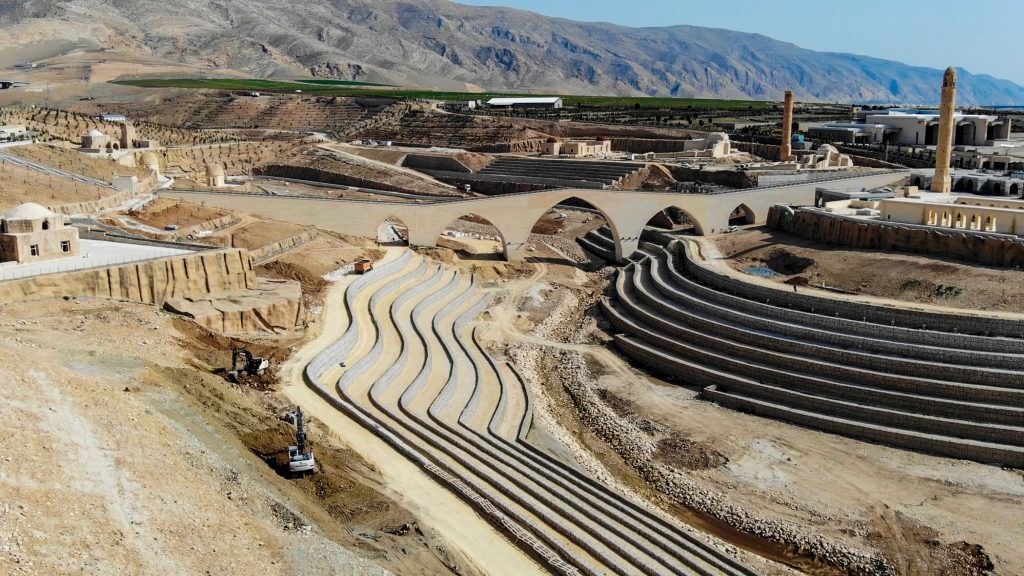
The solution centred on reinforced soil walls built with the Terramesh System — a modular, permeable technology that allows water to pass freely through the structurerather than blocking it, allowing hydrostatic pressure to dissipate naturally.
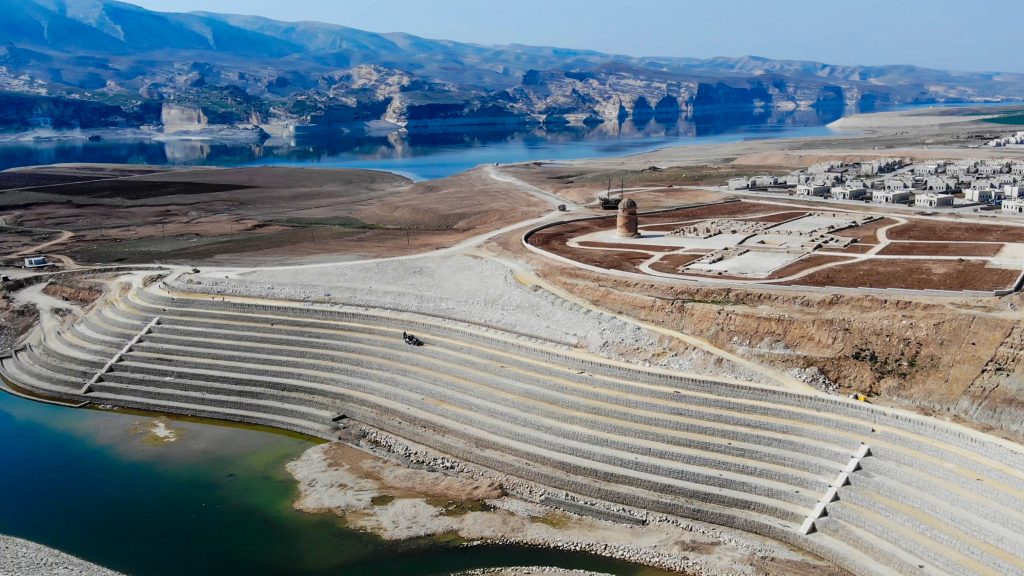
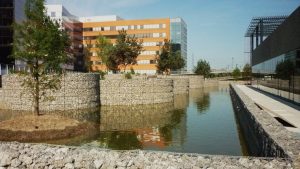
When the Tigris rises, the walls breathe; when it recedes, they drain. Two structural lines were constructed: Line L1 (552 metres, maximum height 27 metres) and Line R1 (246 metres, maximum height 21 metres). To handle earth pressure, a 20 kPa live load, and a 0.11 PGA seismic design load, the Terramesh units were reinforced with high-strength ParaLink geogrids and MacTex nonwoven geotextile installed for separation and filtration layer between the Terramesh and the backfill.
Backfill soil and rockfill for Terramesh facings materials were sourced locally, whichal so significantly reduced concrete consumption, transport costs and the overall carbon footprint compared with the original reinforced concrete wall concept – and because the system installs in wet conditions, construction could continue across two years of fluctuating river levels. The design was verified using Maccaferri’s MacSTARS software to assess both internal and global stability under static, seismic and flood loading conditions.
Barrier in Winter, Terrace in Summer
The stepped berms of the retaining walls, submerged under winter floods, re-emerge each spring as panoramic terraces overlooking the Tigris. Stairs are integrated directly into the wall faces. Visitors walk on what is, technically, a retaining wall — and perceive only landscape. «This is more than a retaining wall», Kermooglu notes. «It is a sustainable infrastructure solution that protects cultural heritage while creating a reliable public space for future generations». Designed for a 120-year service life, the structure is meant to outlast us — holding in place a place that history has already tried, once, to erase.
Article edited by the Second Nature editorial team, with contributions from Ali Kemal Kermooglu, General Manager at Maccaferri Turkey.