
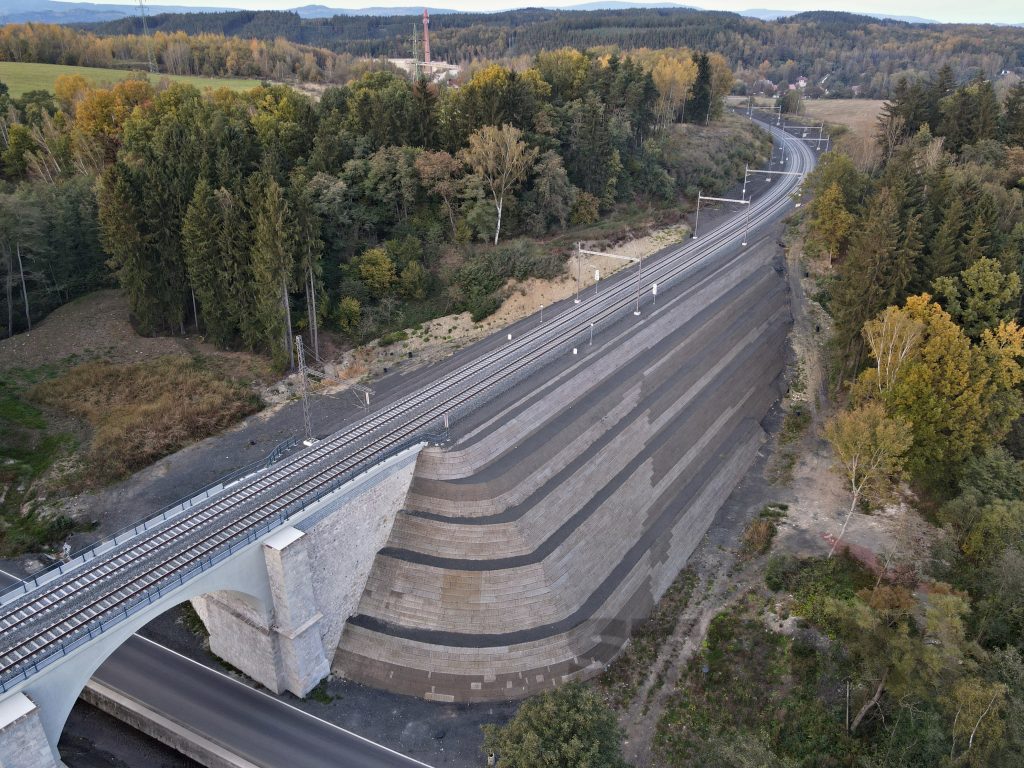
What will become of all of the constructions made by modern humanity? – skyscrapers, factories, sports stadiums, roads (and the cars that drive on them), and our smaller manufactured goods too, computers, mobile phones, plastic beverage bottles, fashion items and much else? These dominate our world now, and we are busy constructing ever more of them. But what will happen to them once they are abandoned or discarded, over the centuries, millennia, and indeed millions of years, to come?
We are palaeontologists, and have begun examining our manufactured creations as possible future ‘technofossils’, just as we once studied the remains of dinosaurs and other ancient organisms. The results surprised us – and show that we will leave a huge legacy to the future Earth, and for countless generations ahead.
One reason is the rapid worldwide growth in the built constructions we live in and manufactured goods we rely on. In the mid-20th century, these added up to roughly a hundred billion tons. By 2000 this mass had grown five-fold, and by 2020 it had doubled again, to exceed a trillion tons of human-manufactured objects – and also exceed the mass of all living things on Earth. It is growing still. This is not just human technological progress: it is a new planetary phenomenon, one that is ever more affecting the functioning of Earth.
There is therefore an enormous mass of new human-made objects on Earth. What increases their chances of becoming potential future fossils is that we have built most of them to last: to be physically strong, and to resist chemical corrosion and biological decay. And, we are helping the process of fossilization further by burying our products underground, whether for their use, as in pilings and foundations, or their disposal, as in landfill sites and nuclear waste facilities. Let us look at a few examples.
Concrete has become the building material of choice worldwide. In post-WWII times its use has soared. In the last seventy years more than half a trillion tons have been produced – enough to place a kilo of concrete on every square metre of Earth, land and sea. Concrete is, in effect, a new kind of man-made rock, and a very durable one; most of its bulk is made of sand and gravel, materials which are among the most long-lasting survivors in the geological realm.
But we have created many new materials too, previously rare on, or completely new to, the Earth. Metals are a prime example. More or less pure ‘native’ metals are a rarity in nature: gold is a prime example, and occasionally copper, and rarely iron (as iron meteorites). But humans have now separated all metals from their ores, and some in gargantuan quantities, such as iron in the form of it we call steel: enough has now been produced to place a steel sphere an inch across on every square metre of the Earth’s surface, to join that kilo-block of concrete. What will happen to these metals, over the geological timespans to come? Some will corrode, others slowly dissolve in underground waters, but a significant proportion might well survive over geological timescales. A fossil iron meteorite has been reported in strata from the time of the dinosaurs, just to show how long this metal can last.
Synthetic plastics are another planetary novelty, that in just seventy years have grown to become an irreplaceable part of our lives, in a myriad different forms. Enough plastic has now been made to wrap the whole world in clingfilm (=plastic wrap), twice over. Much has already been discarded, dumped into landfill sites or simply as litter, spreading by wind and water to reach the highest mountains and the deepest ocean trench. What will happen to plastic? Many websites suggest that plastic objects will decay away after a few centuries, but that is an assertion based on little evidence. Our research suggests that, when buried and kept away from sunlight and oxygen, plastics can last much longer – and we have identified fossilized algae made of a bio-material chemically indistinguishable from polyethylene, that have survived underground, exquisitely preserved, for forty million years. Our plastic goods could leave their mark, literally, to the end of the Earth.
The same durability likely holds true for many of our invisible inventions, such as pesticides and the fluorocarbons like Teflon and other ‘forever chemicals’. Even more delicate materials, like paper, can be preserved into the far future, when one makes comparisons with the equally delicate fossilized plant leaves that are common in some sedimentary strata. The message is clear – we will leave a surprisingly vivid ‘technofossil’ signal in the strata that will last many millions of years.
The significance of this to us is much more immediate, though. If many of our constructions can last millions of years, that means that their damaging and toxic effects are that much more likely to affect us, our children and grandchildren, and the natural world, for generations to come. And, their negative impacts will be magnified as global warming intensifies and sea level rises. As we seek to build a bright new future, we should pay ever more attention to what we leave behind, to reduce this troubling legacy.
Jan Zalasiewicz
Emeritus Professor of Palaeobiology at the University of Leicester
Sarah Gabbott
Professor of Palaeontology at the University of Leicester
Further Reading
Gabbott, S. and Zalasiewicz, J. 2025. Discarded: How Technofossils will be Our Ultimate Legacy. Oxford University Press, 230 pp.
Last Articles

The meaning of work: flourishing, not just producing

Frugal Economy: making things bear fruit, not just cutting back