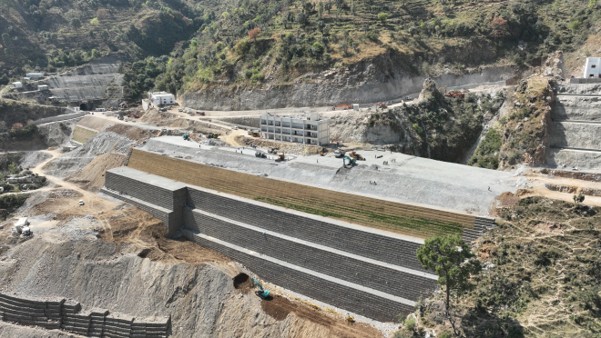
In the folds of the northern Himalayas, along the Udhampur-Srinagar-Baramulla railway line, construction is not a static calculation but a continuous dialogue with the forces of the Earth. Along the Udhampur-Srinagar-Baramulla railway line, it was necessary to heed a landscape of sheer slopes and chronic instability. Thrust zones—faults with shear phenomena—intertwine with high seismic risk, demanding unprecedented technology: a ballastless railway infrastructure on a concrete slab, in a space where a standard embankment would have required a width of 150 meters, impossible within the mountain gorges.
Embracing flexibility: moving beyond the myth of rigidity
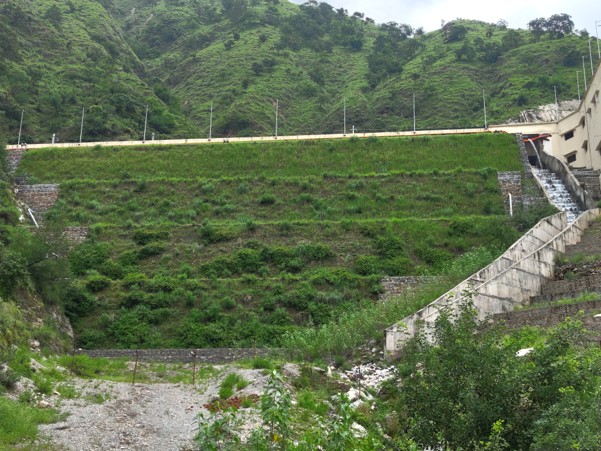
Concrete retaining walls was one of the solutions, but the terrain ruled them out: narrow roads, extremely deep foundations, and the risk of catastrophic fractures under seismic waves. Additionally, concrete viaduct was considered another solution which entails higher cost. The choice fell on the TerraMesh system integrated with ParaLink geogrids, capable of absorbing ground movements and economical. This set off a virtuous cycle: the 300,000 m³ of rock debris from the tunnel excavations, which could not be disposed of due to environmental restrictions, was reused as fill to level the valleys and connect the tunnel access points.
Rigor and material: validating live rock
IIT Madras oversaw a rigorous scientific protocol. To verify that the crushed rock would not tear the geogrids, an “Installation Damage Test” was conducted on-site: a section of ParaLink was buried, compacted, and then extracted to measure its residual strength, with results exceeding expectations. Screening buckets sorted the materials on-site; density and friction checks were performed every 3,000 m³ laid. Even the seepage water from the tunnels was chemically analyzed to ensure the structure’s long-term durability.
Tailored engineering: stitching the infrastructure to the landscape
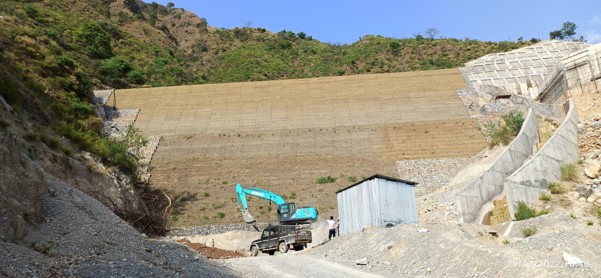
The construction site operated according to a “Design as you progress” approach. At Bridge 40, a bowl-shaped terrain configuration with a single access point required materials to be lowered from above for 50 meters. At Bridges 41 and 42, earthworks were carried out asymmetrically to preserve existing waterways. Where space did not allow for standard reinforcements, the geogrids were shortened and innovative shored reinfroced soil solution was adopted with geogrids tied to the mountain using soil nailing. The MacDrain drainage geocomposite effectively managed seepage arising from rainfall infiltration along the 55-meter-high walls; the top 5–6 meters of the structure were reinforced with additional layers of ParaLink to withstand the 75 kPa dynamic loads required by railway standards.
A manifesto for tomorrow: a living structural ecosystem
The completion of this project propels engineering into a new era, demonstrating that the infrastructure of the future need not impose itself on nature, but can become its guardian and ally.
The project reduces the carbon footprint by at least 80% compared to traditional methods, thanks to the elimination of viaducts and the reuse of tunnel excavated materials. The Green TerraMesh system with hydroseeding promotes the regrowth of native vegetation, enabling the structure to evolve into a living structure that blends seamlessly with its environment; the use of MacDrain has avoided the extraction of gravel from local rivers. The project generated 876,000 man-hours for two of the five planned structures and cuts travel time between Jammu and Srinagar from 6 to 3.5 hours, connecting 150,000 residents previously isolated by landslides and floods. The cost savings exceed 50% compared to a traditional viaduct.
Awarded at the IGS Corporate Case Study Competition in Brisbane, this project by Maccaferri demonstrates that reinforced soil technologies also work in high-altitude and high-risk contexts, paving the way for replicable civil infrastructure solutions in challenging environments. It is tangible proof that, by integrating engineering boldness and ecological sensitivity, humans can inhabit the globe’s most challenging environments not as a disruptive element, but as an integral part of a new, harmonious hybrid landscape.
Article edited by the editorial staff of Second Nature Lab, with the contribution of Dr. Ratnakar R. Mahajan, Regional Technical Manager - ISEAP (India, SouthEast Asia and Pacific) - Maccaferri Environmental Solutions Pvt. Ltd.
Last Articles
The meaning of work: flourishing, not just producing
Frugal Economy: making things bear fruit, not just cutting back